
Cards A$15 – A$6,000 · crypto from 0.0001 BTC · deposits free and instant · no PayID, POLi or BPAY · no published payout timetable
Oshi Australia/Withdrawals
Rails, fees and the gaps
Money reaches an Oshi account through two doors, cards and coins, and it leaves the same way. The operator documents the way in with a full fee-and-limit grid. The way out it barely documents at all — so this page marks that line instead of papering over it with figures somebody guessed.
Funding is the half Oshi documents properly. Its Australian payments page holds a nine-row grid with fee, speed and limit columns, and every row of it reads free and instant.
Cards lead. Visa, Mastercard and Maestro each take between A$15 and A$6,000 in one movement, which matches the A$6,000 ceiling on the welcome package. Six coins follow, each with a floor and no stated ceiling at all.
| Method | Fee | Speed | Limits |
|---|---|---|---|
| Visa | Free | Instant | A$15 – A$6,000 |
| Mastercard | Free | Instant | A$15 – A$6,000 |
| Maestro | Free | Instant | A$15 – A$6,000 |
| Bitcoin | Free | Instant | From 0.0001 BTC, no upper limit |
| Bitcoin Cash | Free | Instant | From 0.001 BCH, no upper limit |
| Ethereum | Free | Instant | From 0.01 ETH, no upper limit |
| Litecoin | Free | Instant | From 0.01 LTC, no upper limit |
| Ripple (XRP) | Free | Instant | From 0.001 XRP, no upper limit |
| Tether (USDT) | Free | Instant | From 5 USDT, no upper limit |
Two details deserve lifting out. The card floor of A$15 is half the A$30 a welcome offer needs, so a small deposit can fund an account without triggering any bonus. And the fee column reads free because Oshi's FAQ says it covers the recipient transaction costs on money coming in. Your own bank may still charge at its end, and the casino cannot refund that.
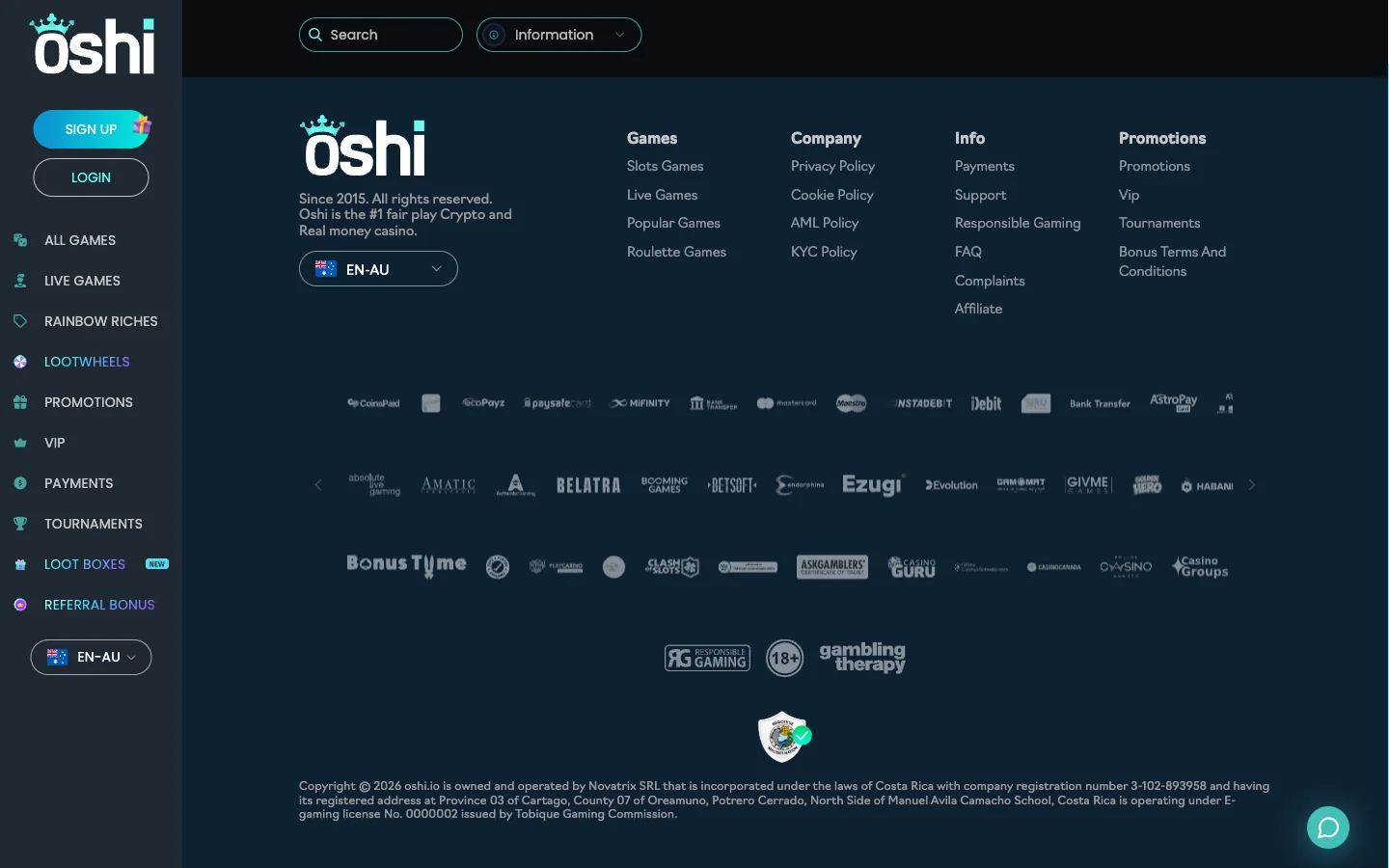
Here is the part no competing page tells you. Oshi's Australian payments table has no PayID on it, and no Osko, no POLi, no BPAY and no Neosurf either — the four rails most Australians reach for first are simply absent from the page that decides what your cashier will show you. Cards and coins, full stop.
The absence matters, because PayID has become the reflex way an Australian sends money anywhere. Several pages ranking above this one imply the familiar domestic rails are waiting in the cashier. They are not. The mix-up is easy enough to trace: the brand's global footer carries a provider strip showing CoinsPaid, ecoPayz, paysafecard, MiFinity, AstroPay, Instadebit, iDebit, bank transfer and Neosurf. A logo strip is marketing. The en-AU payments table is what decides your options the moment you click deposit.
Struck-through chips are missing from Oshi's Australian payments page. Highlighted ones take Australian dollars directly.
So what does an Australian do instead? Two routes, both ordinary. A Visa or Mastercard debit card from CommBank, Westpac, NAB or ANZ runs through the card row and lands in seconds. Or you buy Bitcoin, Ethereum, Litecoin or Tether on a local exchange and send it across, which is nearer to how this operator was built — it has called itself a crypto casino since 2015.
Now the awkward part, and the reason this page is worth your time.
Oshi publishes deposit limits. It does not publish withdrawal limits. There is no processing-time table either — no instant, no 24 hours, no five business days. I went through the payments page, the FAQ and the terms hunting for it, and the number is not there to quote.
What the operator does state is who pays, in two FAQ sentences pointing opposite ways. On deposits: “We will cover the recipient transaction costs”. On withdrawals: “you pay the fee the payment provider charges”. Money in costs you nothing. Money out costs whatever the rail charges, which is typically nothing on a card and the network fee of the moment on a chain transaction.
| Detail | Status | Source |
|---|---|---|
| Deposit limits per method | Published | en-AU payments page |
| Withdrawal minimum | Not published | — |
| Withdrawal daily or monthly cap | Not published | — |
| Withdrawal processing time | Not published | — |
| Who pays the transaction fee | Published | Operator FAQ |
Rival pages fill those blanks with confidence and nothing else. One quotes a €20 minimum, another A$50. Daily ceilings appear as €4,000, A$500 and A$5,000 across three sites, and monthly figures run from €10,000 up to €45,000. None cites a source, and they cannot all be describing the same casino. A table of invented limits is worse than an honest gap, because a reader builds a bankroll plan on it and finds out with money already inside.
Before funding an account you intend to win from, open live chat and ask what the withdrawal minimum and the daily and monthly caps are for an AUD balance. Keep the transcript. A written answer from support is the nearest thing to a commitment on offer while the public pages stay quiet.
Crypto being quicker is not a claim about how fast Oshi's staff work. It is a claim about the pipes.
A card payout does not reverse a card deposit. Deposits authorise in a second or two, because authorisation is all they need. Sending money back means a credit travelling from the acquirer, through the scheme, to your issuing bank, which posts it on its own schedule. Several institutions, business hours at each, none of them answerable to the casino.
A chain payout has none of that. Once signed, the transaction is on the network, and settlement depends on the coin and the fee attached rather than on anybody's banking calendar. Litecoin and Ripple confirm briskly. Bitcoin can drag when the mempool is busy.
Be clear about what this does not tell you. Oshi publishes no processing time for either route, so whatever review happens before a payout is released is unknown on both sides. The deposit grid already shows where the engineering went: six coins, free, instant, uncapped at the top.
Oshi's FAQ takes an unusually relaxed line. Accounts are typically not verified when money is paid in or withdrawn, verification is requested where fraud is suspected, uploaded documents are usually approved right afterwards, and your status shows in your profile.
Read that generously and it describes a casino that will not hold your money over a utility bill. Read it carefully and there is a catch. Verifying late is not the same as never verifying — it means the check, when it comes, lands while you are trying to take money out. That is the worst possible moment to find your passport photo is on an old phone.
So get ahead of it. An offshore casino usually asks for some mix of the following, and clear photos turn a multi-day hold into an afternoon.
The details have to match what you typed at sign-up, so it pays to get that right first time. The Oshi registration page covers the form field by field, including the dropdowns that shape how your balance behaves later.
Oshi will hold your balance in Australian dollars. That sounds trivial. It is not.
The account supports AUD alongside eleven other fiat currencies — EUR, USD, CAD, NZD, NOK, PLN, ZAR, INR, RUB, CNY and BRL — plus crypto, and players can add currencies and switch between them. An Australian visitor lands on the sign-up form with AUD already chosen.
Every movement across a currency boundary is priced by somebody, and that somebody is not you. Fund a euro-denominated account with an Australian card and your bank converts on the way in. Win, withdraw, and it converts again on the way back. Two spreads on the same money, neither one itemised. Pick AUD at the start and both vanish.
Crypto carries a quieter version of the same problem, and almost nobody writing about this brand mentions it. A balance held in Bitcoin or Ethereum floats against the dollar the whole time it sits there. Deposit 0.01 ETH, play for a fortnight, withdraw 0.01 ETH, and the dollars coming back may be well above or well below what you put in. Your gambling result and your currency result arrive as one number.
Most held payouts are not disputes. They are a condition in the account that has not been met, and the symptom usually names the cause.
| Symptom | Likely cause | What to do |
|---|---|---|
| The withdraw button does nothing | An active bonus is locking the balance | Finish the requirement, or forfeit the bonus and cash out the real money underneath it |
| Payout refused, wagering still owing | The 40× requirement on the bonus or spin winnings is unmet | Check the remaining turnover, then read the maths on the Oshi bonus page |
| Documents requested mid-payout | Late verification, triggered by the withdrawal itself | Upload everything at once; the FAQ says approval usually follows straight after |
| Card payout sent, never arrives | Your issuing bank rejected a credit from a gambling merchant | Ring the bank about the return, then use a coin rail next time |
| Crypto sent to an address that never received it | Right coin, wrong network — the classic USDT mistake | Nothing on Oshi's side undoes this. Confirm the network before pasting |
| You cancelled a pending payout and played it away | Reverse withdrawal: the money returns to your playable balance while it queues | Request only what you mean to keep, and stay out of the cashier until it clears |
That last row costs Australians the most money, and it is entirely self-inflicted. A pending withdrawal is not gone yet, and a bored player at midnight can pull it back in two clicks.
Short version: you usually cannot have both.
Bonus funds at Oshi carry a 40× requirement, and while it runs your bets are capped at A$5 each. Free spins and their winnings live seven days. Withdraw before the requirement clears and the bonus, plus whatever it produced, normally goes with it — you keep your deposit, not the extra. Decide which you actually want before you touch the cashier. The turnover arithmetic and the welcome codes sit on the Oshi bonus codes page, and the spin tranches with their expiry clocks are on free spins.
Oshi does not publish one. The payments page carries deposit floors only. Sites quoting €20 or A$50 are guessing, and they disagree with each other, so ask live chat for the figure in writing before you fund a large balance.
No processing time is published for any method. The structural answer: a coin payout is a network broadcast once released, while a card payout travels back through the acquirer, the scheme and your bank, which takes days rather than minutes.
No. PayID is absent from the Australian payments page, as are Osko, POLi, BPAY and Neosurf. What is listed is Visa, Mastercard and Maestro plus six cryptocurrencies, and nothing else.
You do. The FAQ says the player pays whatever the payment provider charges on the way out, while incoming transaction costs are covered by the casino. On a chain payout that means the network fee of the day comes out of your amount.
Often yes, through the Visa or Mastercard row, from A$15 up to A$6,000. Be ready for a refusal though, because every major Australian bank offers a gambling block and issuer risk rules decline offshore gambling merchants even when no block is on.
Almost always at the bank end. The refusal happens before Oshi sees the payment, so support cannot override it. A gambling block, an issuer policy on offshore merchants, or an automated fraud rule are the usual reasons.
Not routinely, going by the operator's FAQ, which says accounts are typically not verified when money moves either direction. Because the check is late rather than upfront, it can land exactly when you request a payout, so keep identification and a recent bill ready.
Yes, and you should. AUD is one of twelve fiat currencies the account supports, it is preselected for Australian visitors, and choosing it removes a conversion spread on every deposit and payout. Currencies can be added or switched later.
None is published, which is exactly why the figures floating around vary by a factor of ninety between sources. Treat any cap you read elsewhere as unsourced until support confirms it for your currency.
Cashing out before the 40× requirement is met normally forfeits the bonus and anything it produced, while your own deposited funds stay yours. If the requirement is nearly done, finishing it is usually the better call.
Nine funding methods, every one free and instant, with an AUD balance available from the first click.
Open Oshi